
Sell-Side Carve-Outs: Designing for Deal Success
The critical design choices that shape deal success before execution even begins.
CARVE-OUTSM&ADIVESTMENTSVALUE CREATION
7/6/20262 min read
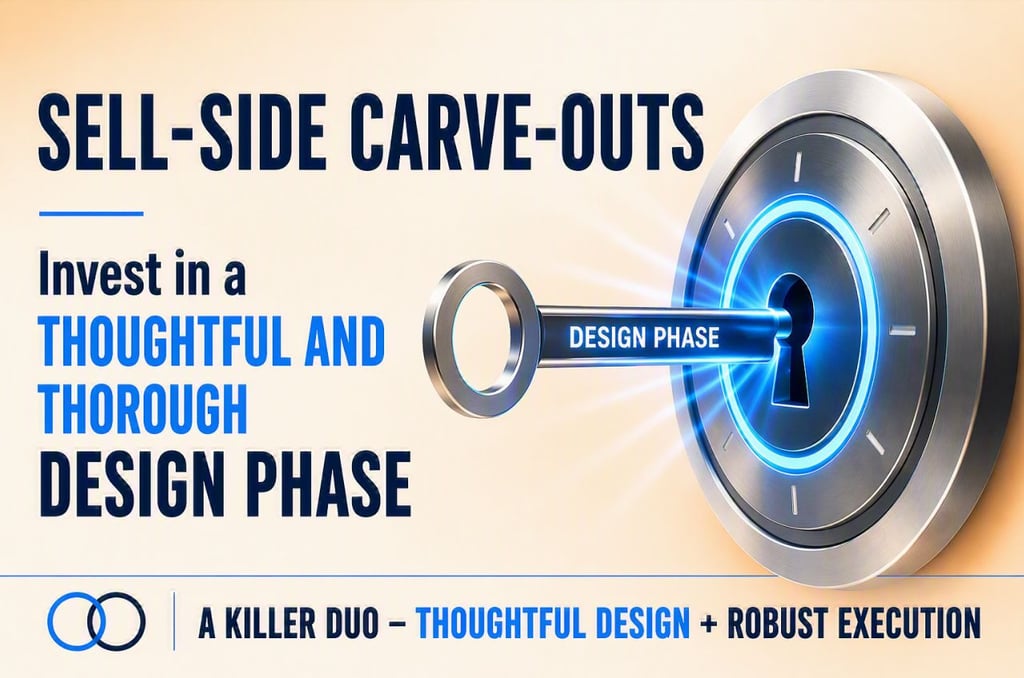
If you sit across a Seller exploring a sale, the conversation quickly turns to a handful of critical design choices.
For e.g.,
What is the preferred buyer profile for the Target?
Should we offer optionality or bundle all assets into a single sale?
Should we offer TSAs?
Dissecting most successful separations gives us a common denominator:
A thoughtful and deliberate Design Phase.
Why?
Because a carve-out offers window of transformation for Sellers. And, Design Phase sets the foundations of that transformative journey - how is the sale structured and what outcomes to expect? Combined with robust execution, it's the killer duo that delivers the intended value.
What are some non-negotiables Design principles worth considering?
1. Precisely define the sale perimeter
Separation perimeter is not the output of a carve-out, instead its basic foundation.
Just a high level view of perimeter is not enough.
What Legal entities, products, contracts, employees, IP, licenses, or shared assets are to be sold - need absolute precision before launching a Sale.
As a first step, companies need to do a detailed Fit, Fix or Free assessment of their portfolio.
2. Optimise Legal entity ( & Tax) structure early
Experienced Sellers know the significance of this step - a potential to rationalize legal entity structure and improve tax efficiency, particularly in a multi-country sale.
Especially, when the perimeter does not already sit within a clean legal structure.
These are effort-intensive items and worth thinking through.
3. Create financial transparency before buyers ask for it
Buyers can tolerate complexity, they struggle with ambiguity.
Presenting robust deal financials is one of the fastest ways to build buyer’s confidence.
Beyond financial health, they are keen to assess fitment into their operating model and various integration scenarios.
Good financials lay out those scenarios, together with assumptions and financial impact.
4. Prepare the separation before launching the sale
Getting the basics right early on is a key antidote to value-slippage.
Timely investing in Separation Planning minimizes impact on BAU while maintaining the necessary rigour.
Investing in a strong Separation Program, with clear budget, owners, and dedicated RACI pays off eventually.
💯 Final reflection
Successful sell-side carve-outs have not just a robust execution to thank; but equally to a Deliberate and thoughtful Design Phase.
What Design discussions with Seller stood out for you?
EQUS Advisory Limited
Operational M&A and Value Creations Specialists
+44(0) 7512040928
© 2025 EQUS Advisory. All rights reserved.